Showing posts with label CoBI. Show all posts

Thursday, July 2, 2015

How Community Builders, Anhart Foundation and CoBI are Improving Maternal and Newborn Health Care in DRC

In 2013, I came face to face with the reality of how women in rural areas die from pregnancy and childbirth related complications. I had a chance to visit dilapidated maternity wards in the Uvira villages of DR Congo and the remote Kasanga villages of Tanzania. A Community Builders intern from Canada, David, narrated to me how he witnessed a good number of deaths of babies in just one night as he and Bertha Kisuda of CNI were on a night shift in the hospitals in Sumbawanga, Tanzania. It was heart breaking.
 
Women are the most vulnerable at childbirth and children are vulnerable in DR Congo, especially up to five years of age. Global measurements of maternal death and child mortality are among the highest in DR Congo. The Save the Child Society rates DR Congo as the most dangerous place o


n earth to be a woman, even though a small number of the other nations such as Chad and Central Africa Republic have slightly higher rates of maternal death.

Most maternal deaths are preventable, as the health-care solutions to prevent or manage complications are well known. All women need access to antenatal care in pregnancy, skilled care during childbirth and support in the weeks after childbirth. CoBI has constructed three maternity clinics, in Bukavu, Uvira and Mumosho. On average, one baby is born every day in the clinics (approximately 350 births per year). This local statistics fits with birth rates in DR Congo (34 births, per year, per 1,000 population).  Thus, in a DR Congo community such as Kahungu which has 12,000 persons, approximately 400 births would be expected annually.  The statistics indicates that almost all the births are occurring at the maternity clinics.

The clinics have a small reception room, a delivery room and room with four beds for after care. The maternity clinics are reducing maternal death and child mortality. CoBI nurses state that in conditions of extreme poverty in DR Congo, 4 out of 10 women will die in child birth in their lifetime without adequate maternity health supports.  Published statistics for all of DR Congo place the risk at 1 in 10, however, in villages of extreme poverty the higher death rates are plausible, especially if a village reaches a 10% or greater risk of death for each birth and if total number of pregnancies reach a total of 10 or more.


The clinics also promote child health and reduce the overuse of local dispensaries which dedicated most of their resources and space to maternity issues before the construction of the maternity centers.  I have compiled some picture of the newly built maternity clinics.


Below are some of the pictures of the new maternity wards in DRC. 

This is a picture of 'Helga Schmidtke maternity ward', constructed in Kabanda village of Mumosho.


This is a picture of a maternity ward constructed in Uvira.
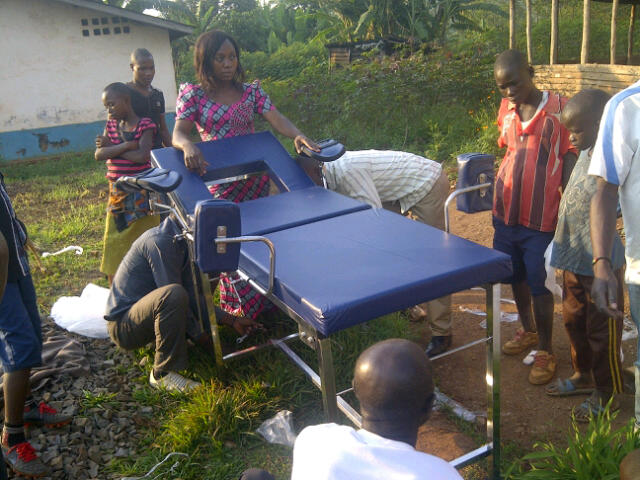


​This is a picture of delivery and ordinary beds donated to 'Helga Schmidtke maternity ward', constructed in Kabanda village of Mumosho.

Wednesday, July 16, 2014

Harvesting

It is harvesting time. 
 
The first week of July, CNI harvested their corn. 
This week, Morogoro PAG Community Development, which is a  registered CBO, harvested rice.
Now, CoBI is in the process of harvesting their corn.  CoBI has already constructed the pig enclosure and housing structures and is now looking for pigs and feeds.
 
This  picture shows  the maternity ward that CoBi is constructing at Kikongo village nearby Uvira.
They had to also rehabilitate a small bridge found half way to the construction site. 
 
This maternity ward will help improve maternal and newborn health care services in the villages of extreme poverty.

Monday, May 12, 2014

Community Based Initiative Update

This year, CoBI has started to implement a new development plan that encompasses humanitarian Aid, in villages of Ikoma, Mumosho, and Kalungwe-Uvira, as well as the economic development project at Katonga that involves corn (maize) and pig farming.

CoBI is growing corn on five hectares at Katogota. Some villagers were hired to weed the farm for the second and last time.  This second weeding is now complete and CoBI is waiting now for the harvest in July of this year.

CoBI has also hired some villagers at Katogota to make the fence and the pig housing structures. 

Within the humanitarian aid framework, CoBi has distributed goats to a good number of people living in extreme poverty in the villages of Ikoma and Kalungwe-Uvira.  CoBI staff and beneficiaries in the villages decided on what to do with this balance of the funds that was allocated for this particular project. 

For example, at Kalungwe-Uvira, the villagers requested CoBI to allocate the balance to the purchase of more vet drugs for their goats. The management committee (formed of 3 people from the group of beneficiaries) was requested to keep and use that money when need be.  But at Ikoma, the remaining money was used to purchase goats that were also distributed to other poor families. CoBI did exactly what the beneficiaries wanted to do with that balance. So CoBI distributed more goats than planned

In addition to goat distribution, CoBI has also installed a community grinding mill at Ikoma.

Tuesday, May 6, 2014

Kahungu and Mumosho Grinding mills Project

Kahungu and Mumosho are remote villages in DR Congo where residents live in conditions of extreme poverty.  In the past, the women in these villages had to walk long distances to access a grinding mill, where grains like maize, wheat, millet, dried arrowroot, cassava, etc., are turned into flour.  The flour is then used in the daily preparation of food. To access these mills, the women were required to walk an entire day's journey to and from these locations. If a person were unable to make the trip, they would be forced to grind grains the manual way, with a motor and pestle. This is a very strenuous and a long process. 

The villagers addressed this need in one of the meetings held by CoBI (PiF's local partner organization). With the support of Anhart Foundation, CoBI bought grinding mills and had them installed in the villages of Kahungu and Mumosho. The people of these villages now have their own grinding mills, enabling them to, not only save time, but to stimulate local business.